
 Indonesian
  Malay
Malay  Vietnamese
  Slovenian
  Slovak
  Latvian
  Bosnian
  Icelandic
  Ukrainian
  Georgian
  Serbian
  Croatian
  Belarusian
  Romanian
  Estonian
  Hungarian
  Czech
Czech  Catalan
  Norwegian
  Lithuanian
  Albanian
  Hindi
Hindi  Italian
  Finnish
  Arabic
  Danish
  Bulgarian
  Thai
Thai  Polish
  Swedish
  Greek
Greek  Portuguese
  Dutch
Dutch  Turkish
  Russian
  Deutsch
  French
  Korean
  Japanese
  English
 Products
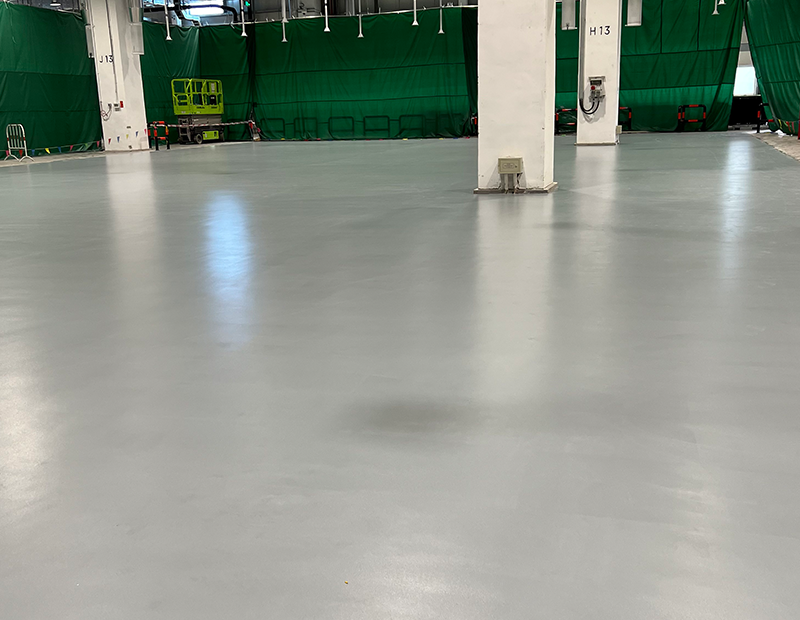
Polyurethane epoxy floor paint system
Product Details
Product features
-
Strong adhesion and good flexibility;
-
The coating is dense, the surface is smooth and it is extremely easy to clean.
-
The coating is wear-resistant, impact-resistant, pressure-resistant and has a long service life.
-
Oil-resistant, water-resistant and various organic and inorganic chemical media;
-
Good insulating properties;
-
The construction is fast and the cost is low
Scope of application
Applicable to the concrete surfaces inside various buildings
Electrical, electronic and mechanical manufacturing factories, workshops, warehouses
Food, medicine, chemical industry, tobacco, textile, clothing
Furniture, light industry, plastics, manufacturing of cultural and sports goods, parking lots
Hypermarkets, etc.
| Technical Specifications | |||
| Performance | Item | Technical Index (GB/T22374-2018) | Test Result |
| Drying Time | Tack-free time, h | ≤ 8 | Compliant |
| Hard dry time, h | ≤ 48 | Compliant | |
| Hardness | Pencil hardness (scratch) | To be agreed | 3H |
| Abrasion Resistance | 750g/500r | ≤ 0.030 | 0.022 |
| Impact Resistance | Heavy load | 1000g steel ball, 100cm height; no cracks/peeling of coating | Compliant |
| Skid Resistance | Dry friction coefficient | ≥ 0.50 | 0.55 |
| Water Resistance | 168h | No blistering/peeling; slight discoloration allowed | Compliant |
| Chemical Resistance | Oil resistance (120# solvent gasoline, 72h) | Same as above | Compliant |
| Alkali resistance (20%NaOH, 72h) | Same as above | Compliant | |
| Acid resistance (10%H₂SO₄, 48h) | Same as above | ||
| Matching Instructions | |||||
| Coating Layer | Material Model | Packaging Specification | Mix Ratio | Single Coat Consumption (kg/㎡) | Single Coat Thickness (mm) |
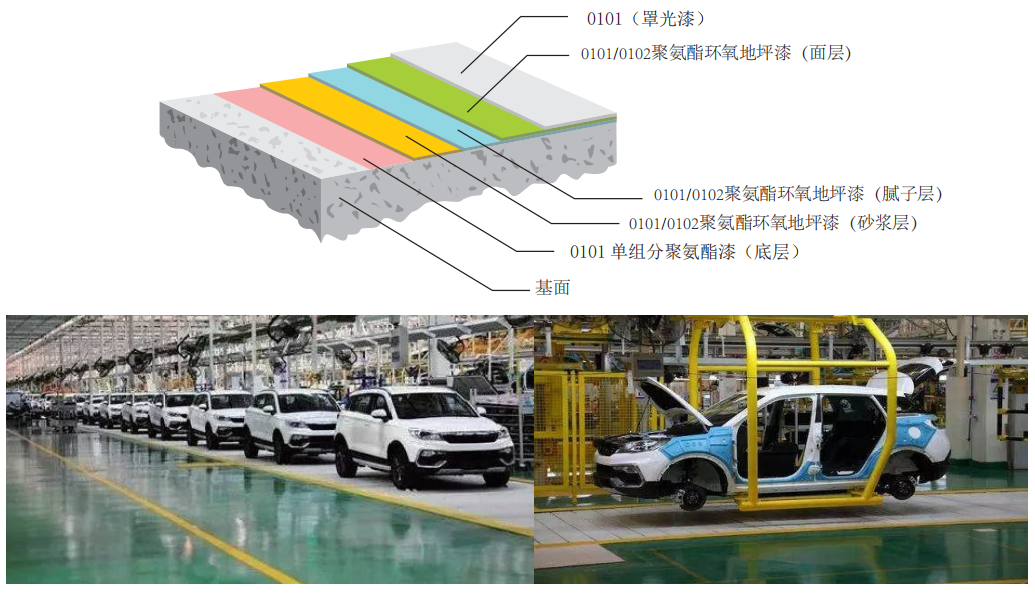
| Primer Coat | OVG-0101 Single-component Polyurethane Paint | 15KG | Single-component | 0.1-0.15 | 0.05-0.08 |
| Mortar Layer | OVG-0101/OVG-0102 Polyurethane Epoxy Floor Paint | 15KG/20KG | 3:04 | 0.3 | 0.25-0.30 |
| Putty Layer | OVG-0101/OVG-0102 Polyurethane Epoxy Floor Paint | 15KG/20KG | 3:04 | 0.1 | 0.07-0.08 |
| Topcoat 1 | OVG-0101/OVG-0102 Polyurethane Epoxy Floor Paint | 15KG/20KG | 3:04 | 0.15 | 0.08 |
| Finish Coat | OVG-0101 Single-component Polyurethane Paint | 15KG | Single-com | ||
Notes
-
The construction environment temperature should be 0-35℃, and the relative humidity should be 20%-80%.
-
When the temperature is too low, the drying process slows down; when it is too high, it causes difficulties in construction.
-
If the humidity is too low, it may cause incomplete drying, poor adhesion and other defects. If the humidity is too high, it is easy to have bubbles and heat rash.
-
For severely sandy and dusty floors, the amount of primer used will increase. It is recommended to use the primer to fully penetrate and reinforce until the overall color of the concrete is uniform without whitening, which can prevent the floor from peeling and hollowing.
-
When applying the topcoat by roller, it is necessary to ensure that the overall amount is uniform. There should be no flowing or piling of materials, otherwise the problem of mottling will occur.
-
After the colored paint is applied, the topcoat must be completed within the specified time; otherwise, it will affect the adhesion of the topcoat layer.
-
When applying topcoat containing red pigment, there will be a problem of floating color and mottling. It is recommended to switch to epoxy topcoat for construction.
-
This material has a strong odor. It is recommended to wear protective equipment during construction and avoid continuous construction for a long time.
-
The construction site should have good ventilation. Construction should be stopped when feeling unwell and ventilation and air exchange should be carried out in time.
Technical Statement
To ensure that your project can select the appropriate floor system, please consult our professional technical advisors. For special colors or effect designs, we can manufacture them according to your requirements. Our company can form design schemes of different specifications (thickness, effect, etc.) through flexible matching and combination of various products to meet the personalized requirements of all kinds of customers.
| Construction Process | ||
| Process Name | Specific Methods & Requirements | Single Coat Consumption (kg/m²) |
| Substrate Treatment | 1. Substrate strength: Not less than C20 | / |
| 2. Substrate flatness: ≤5mm when measured with a 2m ruler | ||
| 3. Substrate dryness: Moisture content of substrate surface < 8% | ||
| 4. Repair hollowing and cracks on the ground in advance | ||
| 5. Fully grind the concrete substrate | ||
| Primer Coat | 1. Use single-component polyurethane paint: Roll evenly with a roller | 0.1-0.15 |
| 2. Use a wool brush for edges, corners and machine corners | ||
| Mid-Coat Mortar Layer | 1. Use OVG-0101/OVG-0102: Mix main paint and curing agent in proportion, stir evenly; add quartz sand in proportion and mix uniformly | 0.3 |
| 2. Scrape overall with a trowel; adjust the number of coats as needed | ||
| 3. After curing, grind and remove dust | ||
| Putty Layer | 1. Use OVG-0101/OVG-0102: Mix main paint and curing agent in proportion, stir evenly; add appropriate fillers (quartz powder, talc powder) in proportion and mix uniformly | 0.1 |
| 2. Scrape evenly with a trowel; focus on filling defects like pinholes and air holes; adjust coats as needed | ||
| 3. After curing, fully grind and remove dust | ||
| Topcoat Layer | 1. Use OVG-0101/OVG-0102: Mix main paint and curing agent in proportion, stir evenly | 0.15 |
| 2. Dip the roller into the topcoat and roll evenly; require uniform coating with no missed areas | ||
| Finish Coat | Use OVG-0101 (high-gloss): Stir evenly, then dip and roll uniformly | 0.1-0.15 |
Construction section
Construction conditions
-
Air temperature: 0℃ - 35℃
-
Relative humidity: 20%-80%
-
Moisture content of the base material surface: < 8%
-
The construction site should have good ventilation
-
Dew point temperature: The substrate and the substrate of the uncured coating must be at least 3℃ higher than the dew point temperature to reduce the risk of condensation or mottling of the ground coating
-
For specific details, please refer to the construction plan.